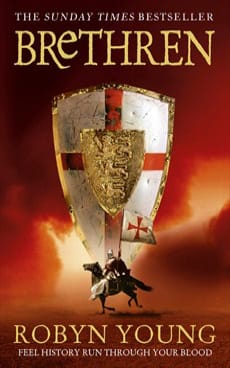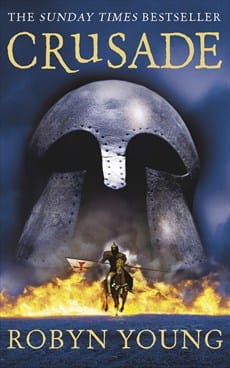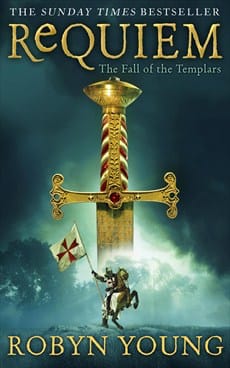
One day in 1999, I was sitting with two friends, who were having a conversation about the Templar Knights. I listened, intrigued by the idea of these medieval warrior monks. Some months later, I came across a book by notable historian, Malcolm Barber, called The Trial of the Templars, which detailed the dramatic downfall of the Order. Their trial, masterminded by the French King, Philippe IV, lasted for seven years and saw the eventual dissolution of this two-hundred-year-old Order, one of the most powerful, influential and affluent of their day. It also saw the imprisonment, torture and execution of hundreds of men across Europe, the descriptions of which made for a harrowing read. By the end of the book I was filled with an overwhelming desire to tell their story: the story of the men behind the myths.
How long did it take you to write Brethren?
From concept to creation, Brethren has been seven years in the making, but that’s not from the first word to the last. It didn’t really work like that. Initially, I had to do months of research before I even began writing. I started the narrative in first-person, with Will as an old man in Scotland looking back on his life. When the agent I now work with first read the synopsis, he loved the idea, but didn’t like the perspective. Soon after, I changed it to third-person and began to tell the story from both the Muslim and Christian points of view. After this, the novel, which had turned into a trilogy, slowly began to take shape. But it took years for me to really find my voice. Every few months, I would send new versions of the early chapters back to the agent and he would give me advice on how to develop them further. This was absolutely invaluable. Two years after our first correspondence, the agent signed me up. But this wasn’t the end and it would be two more years before we found a publisher. I’m not kidding when I say there are eleven versions of Brethren on my computer. The last version, the one Hodder & Stoughton bought, I wrote from scratch in nine months. I feel now that all the earlier versions were training runs for that marathon. I’ve heard other authors say they shouldn’t be called writers, they should be called rewriters. It’s very true!
Did you study history?
No, not since school, and then it was Victorian architecture and Vietnam, neither of which resonated with me much. The enormity of the task I’d set myself quickly became apparent when I read my first book on the Crusades. However, the research soon became a project in itself, one that I immersed myself in as fully as I did the writing.
Do you do your own research?
Absolutely! I can’t imagine not doing my own research. It’s all very well saying to someone, I need to know what date this battle happened on, but that’s just the bare bones. Most of the meat and blood of it I came across by reading, or by accident when I was looking up something else. You can’t ask people to find those things for you. Once, I was researching the layout of the Tower of London and came across a passage that mentioned the fact that King Henry III had a pet elephant. That had to go in. In the end, readers only see a small percentage of what I actually researched in the narrative itself.
How many of the characters in Brethren are real?
There are quite a few real people depicted in Brethren. Baybars was real, as was Khadir, his soothsayer, also Kalawun, Baraka Khan, Aqtai and Kutuz. All of the Templar and Hospitaller Grand Masters mentioned and a few of the officials such as Humbert de Pairaud and his nephew, Hugues, also existed. All of the kings, queens and princes are real.
How much of Brethren is fact?
It’s a real mix of fact and fiction. Battles such as Safed, Antioch and Ayn Jalut all happened. All of the places and most of the background information and histories of the real characters are factual, although in some areas I applied a certain amount of artistic licence. The Anima Templi isn’t, unfortunately, based on fact, although inspiration for the Book of the Grail came from a real source, an anonymous French Grail Romance called the Perlesvaus, written in the thirteenth century.
Where do you write?
In my study, straight onto my computer. I’m on the fourth floor, so the view is pretty amazing. My study leads onto a large balcony with views of the sea and the South Downs.
How often do you write?
It varies. In the early days, I probably didn’t write quite as much as I do now. I didn’t have deadlines then. I’m currently working on the third novel, Requiem, and I don’t have anywhere near the same amount of time to write it as I did with Brethren. I work 6, sometimes 7 days a week and anything from 5 to 18 hours a day. Having said that I do make sure I play hard too.
Where do you get your inspiration from?
First and foremost from the history itself. There are so many incredible, fascinating things that happened during this period, I really don’t have to look too far to find something that will liven up, or advance the narrative. When I started the trilogy, I knew that there were certain historical events that I wanted to use in each of the books. I weave my own plot and fictional characters around these events, which can sometimes be complex to say the least. I find inspiration for individual scenes and chapters can come from almost anywhere, mostly when I don’t have a pen handy. I usually go for a walk before I start writing. The rhythm of feet and breath is surprisingly conducive to the creation of ideas. Someone recently bought me a Dictaphone, which has been a lifesaver. It’s so much harder to come to the computer cold. I need to see a bit of the world and have space to think before I get there.
How do your characters come to you?
The real ones obviously from historical sources, although I do have to put my own personalities onto them and bring them to life, often from fairly scattered and disparate facts. The fictional ones come from anywhere and everywhere. Sometimes they take lots of work, other times they introduce themselves. Everard didn’t even do that. He just barged right past me, plonked himself onto the page and said, this is me, this is my voice and it’s tough if you don’t like it. Garin was extremely painstaking; I had to work and work to find who he was, doing numerous character outlines, working out his history, his likes and dislikes. Will was organic. He grew naturally with me and with my voice as the novel progressed. I think in many ways he is me.
Why do you think the Templars, as a subject, have become so
popular recently? -Is it a Dan Brown thing?
I think the Templars have been popular within Western culture for centuries. Their downfall at the hands of King Philippe IV and Pope Clement V provoked a sympathetic reference in Dante’s Divine Comedy in the early fourteenth century, their perceived corrupt power inspired Walter Scott in the early nineteenth century. The early Freemasons named one of their degrees after the knights. Baigent, Leigh & Lincoln’s book, The Holy Blood and the Holy Grail was an international phenomenon in the early eighties. The Templars are to the French what King Arthur is to the British, and there are literally thousands of books and websites dedicated to them, ranging from the factual to the bizarre. I think Dan Brown paved the way to some extent, in terms of sales, for the novels based on the Templars that have recently become bestsellers, by heightening public awareness of the subject and by proving that an appetite for myths, legends and medieval conspiracies exists. But I think all of these writers, including myself, simply tapped, knowingly or not, into a cultural fascination with the Knights Templar that has existed for years.
Muslims & Christians – what made you decide to tell the story
from both points of view?
When I changed the perspective from first-person to third, early on in the writing of the novel, it enabled me to open up the story to contain a multitude of voices, one of the great advantages of this perspective, in comparison to the more limiting first-person narrative. By this point I had realised, through the research, that I didn’t just want to tell the story of the Templars, I also wanted to tell the story of the great events of their day, namely the Crusades. As soon as I had made this decision, I knew I wanted to tell both sides of that story. It seemed incredibly unbalanced not to and by then I had come across Baybars in the course of my research and had already been captivated by him. At first, what I was writing seemed like ancient history, completely unconnected with the world I lived in. 9/11 changed that. On that day I was writing the speech where Baybars proclaims a new jihad against the West. After this day and during the wars on Afghanistan and Iraq that followed, with members of the British government calling for a Crusade, the world I was writing about and the world I lived in came eerily closer. It was then that Brethren really began to live for me. I didn’t just want to write it, I had to write it.
Why did you decide to write a trilogy?
The initial inspiration for Brethren came from the Templars’ downfall, so that was always going to form a large part of the narrative. My original starting point changed, however, when I began researching Baybars and the Mamluks, and the story split. After I read about the battle of Ayn Jalut, where the Mongols were defeated in battle for the first time, I knew that was where I wanted to begin. But that meant that I would be covering a period from 1260 to the end of the Order in 1314, and because there were now two narratives to contend with, plus a rapidly-growing number of incredible battles and events that I wanted to cover, there was simply no way that I would be able to squeeze it all into one book! The narrative also lends itself nicely to three separate novels, which follow on from one another, yet which each have their own specific story-line. The downfall of the Order will be covered in the third book.
Is Brethren your first novel?
Brethren is my first published novel. I wrote two books of a planned fantasy series in my early twenties, but neither was published. I can look back on them now and see why. But they were great fun to write and they got me over my fear of the massive word counts involved in novel writing.
How do you write a novel?
When I was fourteen, I won a poetry award. The awards were handed out during a prize-giving evening by a novelist, a mature, rather grave-looking gentleman (I have no idea who he was). All through the ceremony, I was building a question in my mind, which had started to form when I was told that he was an author. Finally, when the evening finished, I crept nervously up to him and asked my question. “How do you write a novel?” It was a good question, I thought. There must surely be some definitive answer, a Rosetta stone with which I would unlock the secret. And I wanted to know, I really wanted to know, because for some time, I had wanted to write one. He looked down at me, shook his head at my apparent idiocy and gruffly replied. “You just do.” I was gutted. What kind of an answer was that? How could I possibly write one without knowing how? It wasn’t until ten years later that I understood. You really just do.
You start with an idea and you set the words to the page until months, or maybe decades later, you have a novel. Some writers I know have an overall idea of what the novel will be about, but mostly invent it as they go and don’t always start at the beginning and work through in chronological order. Personally, I’ve found that I cannot start writing until I have the plot entirely worked out, with detailed notes for each chapter, and I work through from the first word to the last in the exact order.
What do you do when you’re not writing?
All the normal things like spending time with friends, going to the theatre, reading, listening to music, travelling. When I have the time, I love to paint. I play tennis (not very well, but I’m getting better), go for walks and although I mostly avoid television I’m utterly addicted to films and DVD series: The West Wing, Six Feet Under, 24, Twin Peaks, Desperate Housewives, Buffy, Firefly (well, anything by Joss Whedon really). It’s my great ambition to work on the script for a film or series one day.
Who is your favourite author?
I am firmly of the belief that to be a good writer you have to be a good reader and therefore I read almost anything. My study is lined with books, from Wilbur Smith to Will Self. I don’t have one favourite author, or book. I’ve liked different things at different times in my life and I find what I pick off my shelves depends entirely on my mood. Some days, I want to be challenged, other days I want to be swept into an adventure. But to give you an idea, here’s a selection of some of my most memorable reads to date, in no particular order:
- The Chronicles of Narnia, C.S. Lewis.
- The Dark is Rising Series, Susan Cooper.
- His Dark Materials Trilogy, Philip Pullman.
- The Warlord Chronicles, Bernard Cornwell.
- A Cook’s Tour, Anthony Bourdain.
- Oranges Are Not the Only Fruit, Jeanette Winterson.
- Macbeth, Shakespeare.
- An Instance of the Fingerpost, Iain Pears.
- The Dante Club, Matthew Pearl.
- Memories, Dreams, Reflections, C.G. Jung.
- Atonement, Ian McEwan.
- Burning Your Boats (selected short stories), Angela Carter.
- The Crow Road, Iain Banks.
- Restoration, Rose Tremain.
- One Hundred Years of Solitude, Gabriel Garcia Marquez.
- The Lion of Macedon, David Gemmel.
- The Lord of the Rings, J.R.R. Tolkien.
- The Barrytown Trilogy, Roddy Doyle.
- The Confesssions, Jean-Jacques Rousseau.
- Perfume, Patrick Suskind.
- The Deathstalker Series, Simon R. Green.
- The Secret History, Donna Tartt.